Trading basicsExplainer
What Are Tokenized US Stocks?
Answer
Tokenized US stocks (often grouped under RWA — real-world assets on-chain) means an issuer under a compliance framework turns US stock/ETF-related economic rights into tokens or on-exchange spot units. What you usually buy is economic exposure to the underlying price. Issuers and platforms generally state it is not direct ownership of the company's shares and does not automatically include voting rights. On Binance the common product name is bStocks; on OKX it is often unified tokenized stocks (codes frequently start with X, e.g. XAAPL). To buy, start with How to Buy US Stocks on a Crypto Exchange, then follow How to Buy US Stocks on Binance or How to Buy Tokenized US Stocks on OKX.
Contents
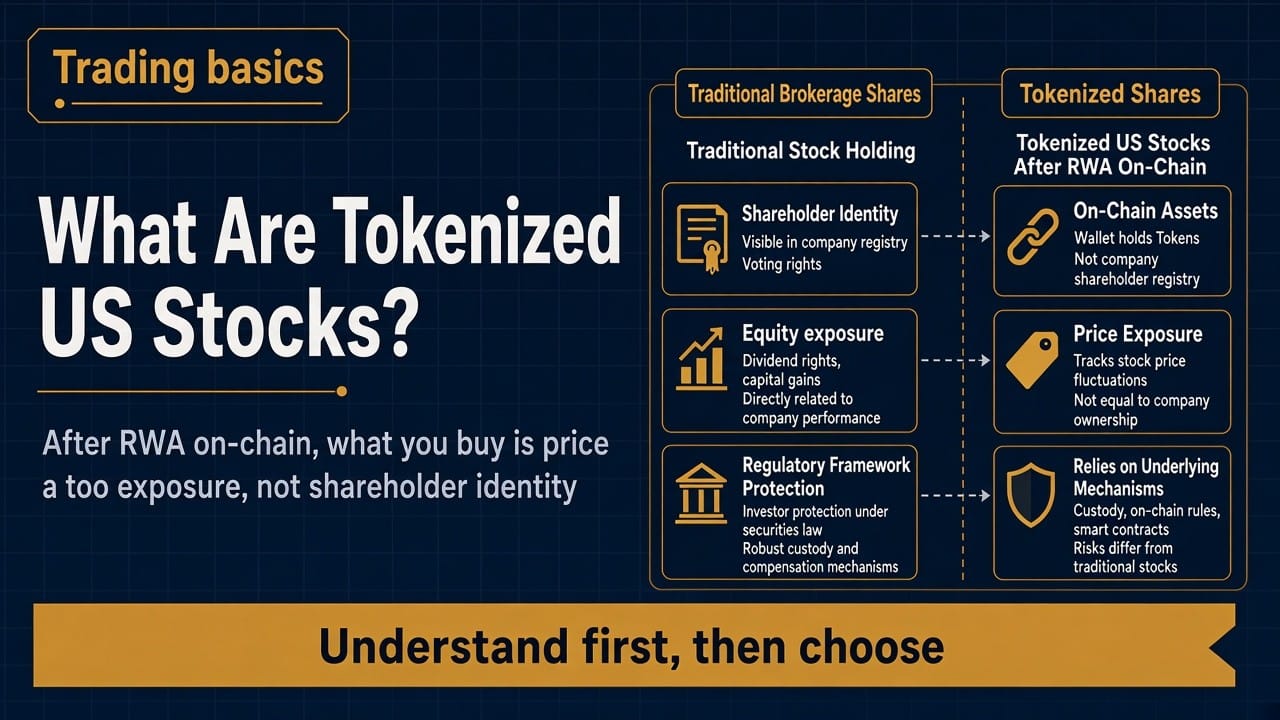
Broker cash equity vs Exchange tokenized US stocks
Want shareholder identity, cash dividends into the account, and a familiar investor-protection frame → broker equity path. Already hold stablecoins, your region shows the CEX product, and you accept price exposure plus issuer structure → then consider tokenized spot. Different risk shapes — not "the same stock through another door."
| Dimension | Broker cash equity | Exchange tokenized US stocks |
|---|---|---|
| What you hold | Often beneficial securities interest under a broker (local rules and agreements decide) | Token or platform-recorded contractual rights; docs usually say not direct equity |
| What you pay with | Mostly fiat into a brokerage | Often USDT/USDC on spot; KYC on the exchange still applies |
| Trading hours | US equity session (plus any pre/post rules) | Spot tokens often claim 24/7; spreads and gaps can widen when the cash market is closed |
| Dividends and corporate actions | Cash dividends often credit (tax follows local and broker rules) | Often reinvested / multiplier adjusted, or without voting rights — read the product sheet; do not assume "same as a shareholder" |
| Extra risks | Broker and market risk, deposits/withdrawals, tax compliance | Issuer/custody, smart-contract and network risk, platform counterparty, regional delisting, off-hours pricing gaps |
Key definitions
- One-line definition
- A tradable on-chain/exchange unit designed to track a US stock or ETF price; 1:1 backing and redeemability follow issuer and platform terms
- What it is not
- Usually not being recorded as a shareholder at a US broker; not a sure-win product; not "listed on an exchange means legal cash-equity trading everywhere"
- Common trading form
- CEX spot (often USDT-quoted, often 24/7); some paths withdraw to a named chain wallet; separate US-stock perpetual futures are derivatives, not tokenized spot
- How to read the ticker
- Binance bStocks often add B after the equity code (e.g. NVDAB); OKX unified tokenized stocks often prefix X (e.g. XNVDA); on-chain issuer names can differ — wrong ticker = wrong asset
- Eligibility red line
- Most products are not offered to US persons / people in the US; elsewhere, availability follows whether the entry appears in your account. Do not use a VPN to bypass restrictions.
What this page does not cover
- Concept and product boundaries only — no guaranteed click path, no endorsement of any platform.
- Does not claim tokenized stocks already legally replace brokers in every jurisdiction.
- Does not mix bStocks, OKX unified tokenized stocks, and US-stock perpetuals into one product.
- Fees, listings, withdraw networks, and eligibility change — official help and in-app prompts win.
- Not investment, legal, or tax advice; no return promises.
FAQ
If it is RWA on-chain, can I buy US stocks on any exchange?
No. The venue must list the product, your residency and account must qualify, and local law must allow it. If the entry is missing, do not work around it.
If I buy tokenized NVIDIA/Apple, am I a shareholder?
Per public Binance/OKX wording, generally not a direct shareholder, and usually without voting rights. For share ownership, open a licensed brokerage path.
Why can weekend prices diverge from the cash close?
When the equity market is closed, token prices are driven more by secondary supply/demand and market-maker quotes; spreads can widen, and gaps can appear when cash trading resumes.
How is this different from US-stock futures?
Tokenized spot usually has no leverage (you can still lose on price). Futures use margin for exposure and can liquidate. See Spot vs Futures Trading: What's the Difference?.
What should I read next?
Start with How to Buy US Stocks on a Crypto Exchange to pick a path; if you already chose Binance or OKX, open that how-to.